Upcoming STEM Explorers Program
A 6-week hands-on STEM experience for young learners
From July 28 to September 5, learners explore radio, electronics, programming, microscopy, astronomy, optics, nature-inspired design, and creative STEM expression.
Dates
July 28 - Sep 5, 2026
Format
2 sessions per week
Venue
Eastern Regional Library's Youth Engagement Center, Koforidua
Cohorts
Morning and afternoon planned
Program Snapshot
Practical STEM, structured for the long vacation
The program gives learners a clear entry point into STEMForge Academy through guided activities, journals, project work, and a final showcase.
Learner identity materials, journals, badges, and activity resources support a sense of belonging and progress.
- Schedule
- July 28 - September 5, 2026
- Duration
- 6 weeks
- Sessions
- 2 sessions per week
- Venue
- Eastern Regional Library's Youth Engagement Center, Koforidua
- Cohorts
- Morning and afternoon cohorts planned
- Slots
- Limited spaces available
What's Included
A complete hands-on experience
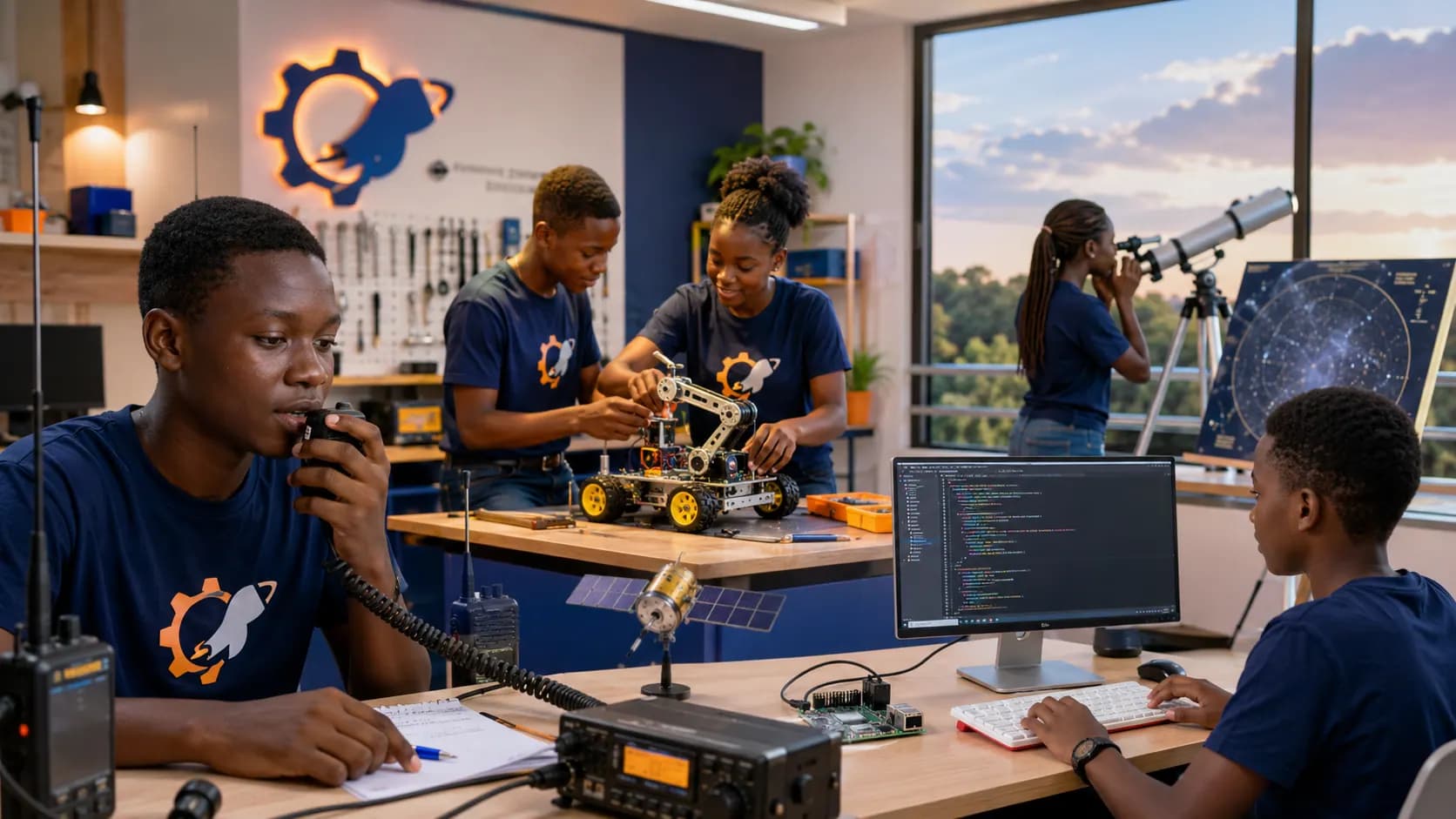
Learners get practical sessions, tools, journals, guided challenges, career conversations, and a final demonstration experience.
Learning Areas
What learners will explore
Each area turns abstract STEM ideas into visible demonstrations, responsible tool use, and beginner-friendly project work.
Radio Communication
Learners explore how information travels through invisible waves. They are introduced to radio discipline, message clarity, signal behavior, antennas, and the public-service tradition of radio communication.
Electronics & Programming
Learners explore basic circuits, components, logic, and systems. They begin to understand how small parts combine to create useful devices.
Optics: The Science of Seeing
Learners explore light, lenses, focus, magnification, image inversion, and the way instruments extend human vision.They discover how optics is a gateway to seeing differently and discovering hidden details, helping learners understand how we can build and use tools to see the very small and the very far.
Microscopy, Morphology & Biomimicry
Learners use microscopes to observe hidden details in everyday materials and natural specimens. They are introduced to morphology: how shape and structure support function. They discover how nature solves design problems beautifully, inspiring creativity and practical design thinking
Astronomy & Sky Measurement
Learners use sky observation, models, special software, and optics-supported astronomical reasoning to explore how humans study distant objects. Astronomy is presented as measurement, evidence, and asking how humans know what they know about distant objects.
STEM Communication & Creative Expression
Learners document and communicate what they discover. They use writing, sketching, storytelling, presentation, and creative explanation to strengthen understanding.
6-Week Flow
From possibility to demo day
The weeks build from exposure and observation into mini-projects, presentation practice, and a final showcase.
Week 1
Possibility, Careers & Seeing Differently
Learners discuss future interests, knowledge, tools, and the importance of structured curiosity. The optics wow experience introduces the idea that tools extend human senses.
Week 2
Signals, Circuits & Systems
Learners explore radio communication, basic circuits, message clarity, and how invisible systems can be tested.
Week 3
Microscopy, Nature & Design
Learners observe hidden structures, explore morphology, and discover how nature solves design problems.
Week 4
Astronomy, Scale & Verification
Learners explore sky observation, parallax, shadows, scale models, and the question: How do we know?
Week 5
Project Challenge & Guest Interaction
Learners work on mini-projects, interact with professionals where available, and prepare to explain their ideas.
Week 6
Final Build, Presentation & Demo Day
Learners complete activities, present discoveries, share journals, and participate in a final showcase.
Parent Notes
Designed for curious learners aged 12 and above
Learners do not need prior STEM experience. They need curiosity, willingness to participate, and openness to learning by doing.
Submission of the interest form does not automatically guarantee placement. Final placement is subject to available places, application review, and payment confirmation.
FAQ
Quick answers for families
A few practical answers about eligibility, equipment, supervision, and completion.
Is STEMForge Academy a formal school?
No. STEMForge Academy is a STEM-focused youth engagement initiative. It organizes practical demonstrations, innovation clubs, camps, competitions, and related youth development activities.
Who can apply?
The program is intended for young learners aged 12 and above who are curious about science, technology, building, discovery, and practical learning.
Does my child need prior experience?
No. The program is designed for beginners and curious learners, aged 12 and above.
Will students use real equipment?
Yes, under supervision. Activities may involve radios, basic electronics, lenses, microscopes, telescopes, journals, and other learning tools.